
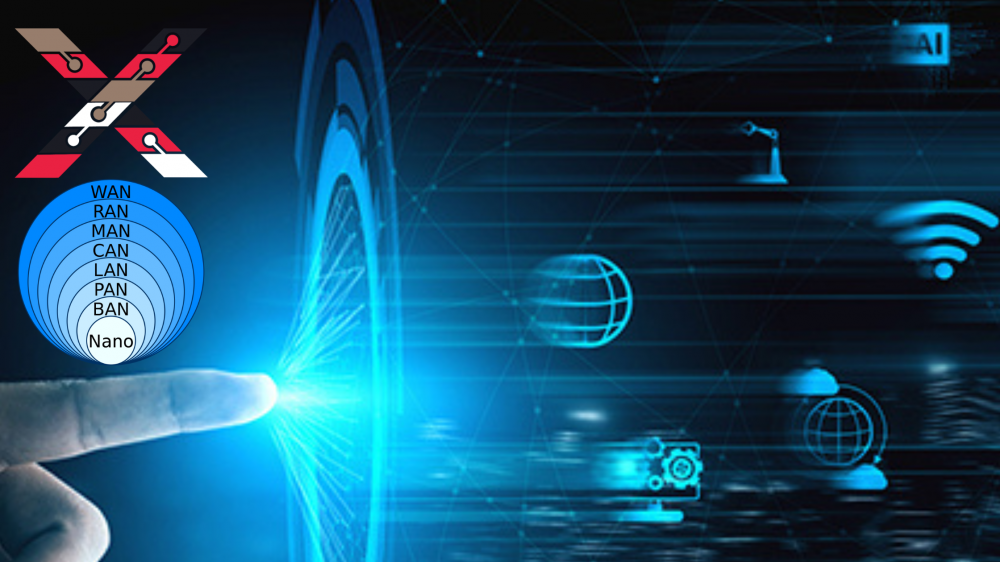
Ethernet is a technical concept that is not common to all technical partners but it is expected that the majority of people are familiar with it. Ethernet is a method of connecting various networks with wires and cables. It is similar to the concept of LAN (Local Area Network) where many computing devices are connected in such a way that they can transfer files and folders between them. To make use of Ethernet to connect computers, one has to make a heavy consumption of cables and ports of various sizes. Tech geeks may also know it from the IEEE 802.3 protocol.
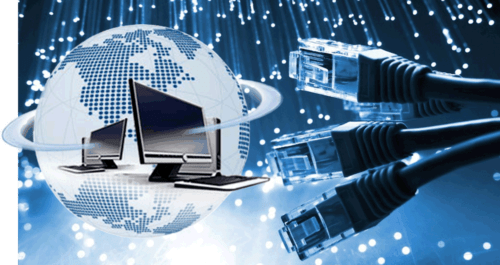
What is IEEE?
IEEE is the world's largest technical professional organization dedicated to advancing technology for the benefit of humanity.
Ethernet is a family of wired computer networking technologies commonly used in local area networks (LANs), metropolitan area networks (MANs), and wide area networks (WANs). It was introduced commercially in 1980 and first standardized in 1983 as IEEE 802.3. Ethernet has since been improved to support higher bit rates, more nodes, and longer link distances, but it retains much backward compatibility. Over time, Ethernet has largely replaced LAN technologies
What is Ethernet
Ethernet is the traditional technology for connecting devices in a local area network (LAN) or wide area network (WAN). It enables devices to communicate with each other via a protocol, which is a set of rules or a common network language.
Ethernet describes how network devices coordinate and transmit data so that other devices on the same LAN or campus network can learn, receive, and process information. An Ethernet cable is the encapsulated physical wire over which data travels.
Connected devices that use cables to access a geolocalized network — rather than a wireless connection — are likely to use ethernet. From businesses to users, diverse end users depend on the advantages of Ethernet connectivity, which include reliability and security.
Compared to wireless LAN (WLAN) technology, Ethernet is less susceptible to disturbances. It can also provide a greater degree of network security and control than wireless technology because devices must communicate using physical cabling. This makes it difficult for outsiders to access network data or steal bandwidth from unauthorized devices.
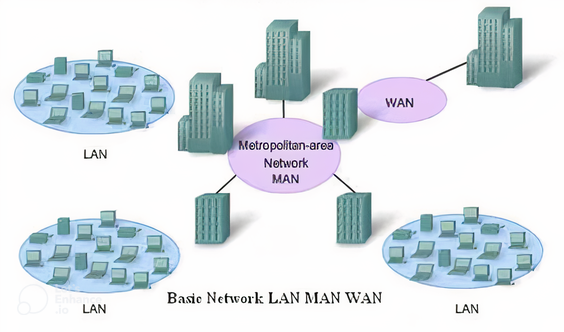
- Local Area Networks (LANs) short for Local Area Networks, are networks that are used to cover small, limited spaces such as a home or office. There are two ways to connect local networks: Ethernet or using routers
- Metropolitan Area Network (MAN) is an abbreviation for the word Metropolitan Area Network. It is a group of local networks that extend over large areas that reach hundreds of kilometers, such as linking branches of a company or branches of a company to all cities of the world.
- Wide Area Networks (WAN) is an abbreviation for the word Wide Area Network and is called wide because it extends to large areas to connect several civil networks between a group of countries such as the global information network (Internet).
What are the requirements for an Ethernet setup?
To set up this wireless network on your computer or laptop, you must have wired input.
The computer and other computing devices must be able to communicate with each other provided that all devices to be connected have an ethernet adapter.
What are the applications of Ethernet?
Ethernet is used to connect devices in a network and is still a popular form of network connection. For local networks used by specific organizations – such as corporate offices, university campuses, hospitals, etc… – Ethernet is used for its high speed, security, and reliability.
The original Ethernet transfer rate of 10 Mbps increased tenfold to 100 Mbps in the mid-1990s. The Institute of Electrical and Electronics Engineers (IEEE) continues to deliver increased performance with successive updates. Current versions of Ethernet can support operations of up to 400 gigabits per second (Gbps).
Advantages and Disadvantages of Ethernet
Ethernet has many benefits for users, which is why it is so popular. However, there are some drawbacks as well.
Advantages of Ethernet:
- Relatively low cost
- Easily compatible with any network (LAN)
- Noise suppression in general
- The speed and quality of data transfer are excellent
- dependability; and data security, where common firewalls can be used.
Disadvantages of Ethernet:
- Intended for smaller and shorter distance networks
- Limited mobility
- The use of longer cables can cause electromagnetic interference
- It does not work well with real-time or interactive applications
- Speeds decrease with the number of devices attached
- Receivers do not acknowledge receipt of data packets; Troubleshooting is difficult when trying to trace the specific cable or node that is causing the problem.